Nobody writes realistic realism, and if they did, no one would read it. The writers that think they write it just give their own ideas about things they think they see. The sort of man who could write realism is the fellow who never reads or writes anything.
— Robert E. Howard
Robert E. Howard on realism
27 February 2011 by Leave a Comment
Scott Meyer: ‘How to Resurrect a Dead Character’
29 January 2011 by Leave a Comment

No sooner had I posted my link to Scott Meyer’s ‘How to Kill Off a Fictional Character’ than Meyer came up with the inevitable sequel:

Rodney lives!
Scott Meyer: ‘How to Kill Off a Fictional Character’
16 January 2011 by Leave a Comment
From the wise and frequently inimitable Scott Meyer of Basic Instructions:

Go thou, and do likewise.
G. K. C. on ‘Thou shalt not’
8 October 2010 by Leave a Comment
‘Thou shalt not’ is only one of the necessary corollaries of ‘I will’. ‘I will go to the Lord Mayor’s Show, and thou shalt not stop me.’
Anarchism adjures us to be bold creative artists, and care for no laws or limits. But it is impossible to be an artist and not care for laws and limits. Art is limitation; the essence of every picture is the frame. If you draw a giraffe, you must draw him with a long neck. If, in your bold creative way, you hold yourself free to draw a giraffe with a short neck, you will really find that you are not free to draw a giraffe.
—G. K. Chesterton, Orthodoxy
P. J. O’Rourke on the writing process
26 July 2010 by Leave a Comment
Writing is a slow and a difficult process mentally. How you physically render the words onto a screen or a page doesn’t help you. I’ll give you this example. When words had to be carved into stone, with a chisel, you got the Ten Commandments. When the quill pen had been invented and you had to chase a goose around the yard and sharpen the pen and boil some ink and so on, you got Shakespeare. When the fountain pen came along, you got Henry James. When the typewriter came along, you got Jack Kerouac. And now that we have the computer, we have Facebook. Are you seeing a trend here?
—P. J. O’Rourke, ‘Very Little That Gets Blogged Is Of Very Much Worth’
John C. Wright on fairy-tale logic
23 July 2010 by Leave a Comment
If the kiss of a princess is the only thing that can turn a frog into a prince, then that kiss and nothing else must be had. Being kissed by a Duchess or a Countess will not do, not even if Parliament so decrees. In a medical thriller or a science fiction story, perhaps, you can have someone discover an unexpected miracle cure, or have Scotty use the Transporter to turn the frog back to his true shape. Science fiction is all about problem solving through technology. Science fiction is about daydreaming. But Fairy stories are about logic.
—John C. Wright, ‘What to Do When Your Outline Breaks’
‘Fenimore Cooper’s Literary Offences’, by Mark Twain
4 January 2010 by 1 Comment
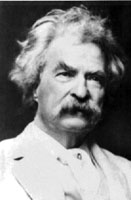
Originally published in the North American Review, July, 1895.
“The Pathfinder” and “The Deerslayer” stand at the head of Cooper’s novels as artistic creations. There are others of his works which contain parts as perfect as are to be found in these, and scenes even more thrilling. Not one can be compared with either of them as a finished whole. The defects in both of these tales are comparatively slight. They were pure works of art. —Professor Lounsbury
The five tales reveal an extraordinary fullness of invention. . . . One of the very greatest characters in fiction, Natty Bumppo. . . The craft of the woodsman, the tricks of the trapper, all the delicate art of the forest were familiar to Cooper from his youth up. —Professor Matthews
Cooper is the greatest artist in the domain of romantic fiction in America. —Wilkie Collins
It seems to me that it was far from right for the Professor of English Literature at Yale, the Professor of English Literature in Columbia, and Wilkie Collins to deliver opinions on Cooper’s literature without having read some of it. It would have been much more decorous to keep silent and let persons talk who have read Cooper.
Cooper’s art has some defects. In one place in “Deerslayer,” and in the restricted space of two-thirds of a page, Cooper has scored 114 offenses against literary art out of a possible 115. It breaks the record.
There are nineteen rules governing literary art in domain of romantic fiction—some say twenty-two. In “Deerslayer,” Cooper violated eighteen of them. These eighteen require: [Read more…]
G. K. C.: ‘On Mr. Thomas Gray’ (excerpt)
23 October 2009 by Leave a Comment
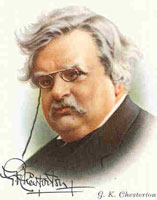
Collected in All I Survey (1933).
A newspaper appeared with the news, which it seemed to regard as exciting and even alarming news, that Gray did not write the ‘Elegy in a Country Churchyard’ in the churchyard of Stoke Poges, but in some other country churchyard of the same sort in the same country. What effect the news will have on the particular type of American tourist who has chipped pieces off trees and tombstones, when he finds that the chips come from the wrong trees, or the wrong tombstones, I do not feel impelled to inquire. Nor, indeed, do I know whether the new theory is proved or not. Nor do I care whether the new theory is proved or not. What is most certainly proved, if it needed any proving, is the complete lack of imagination, in many journalists and archæologists, about how any poet writes any poem. [Read more…]
G. K. C.: Stories vs. literature
20 October 2009 by Leave a Comment
But people must have conversation, they must have houses, and they must have stories. The simple need for some kind of ideal world in which fictitious persons play an unhampered part is infinitely deeper and older than the rules of good art, and much more important. Every one of us in childhood has constructed such an invisible dramatis personae, but it never occurred to our nurses to correct the composition by careful comparison with Balzac. In the East the professional story-teller goes from village to village with a small carpet; and I wish sincerely that any one had the moral courage to spread that carpet and sit on it in Ludgate Circus. But it is not probable that all the tales of the carpet-bearer are little gems of original artistic workmanship.
Literature and fiction are two entirely different things. Literature is a luxury; fiction is a necessity. A work of art can hardly be too short, for its climax is its merit. A story can never be too long, for its conclusion is merely to be deplored, like the last halfpenny or the last pipelight. And so, while the increase of the artistic conscience tends in more ambitious works to brevity and impressionism, voluminous industry still marks the producer of the true romantic trash. There was no end to the ballads of Robin Hood; there is no end to the volumes about Dick Deadshot and the Avenging Nine. These two heroes are deliberately conceived as immortal.
—G. K. Chesterton, ‘A Defence Of Penny Dreadfuls’
[Paragraph break added. —T. S.]
Lewis on novels on Johnson on marriage
5 November 2008 by Leave a Comment
Marriage is not commonly unhappy, otherwise than as life is unhappy.
— Samuel Johnson
I can’t say that would be a whole novel with the moderns because the whole novel would not get as far as that.
— C.S. Lewis



Recent Comments